

G-raphy Camera Bag Backpack with Rain Cover Review
Affiliate disclosure: This article contains affiliate links (paid links). If you buy through them, Proton-Pack may earn a commission at no extra cost to you. As an Amazon Associate I earn from qualifying purchases. Learn about our editorial policy.
Should you buy the older G-raphy camera backpack with a rain cover? The design is worth considering as a budget camera bag because it combines adjustable padding, accessory storage and a cover intended for rainy weather. Its biggest complication is model identification: several G-raphy backpacks have been sold with very similar names but significantly different dimensions and pockets.
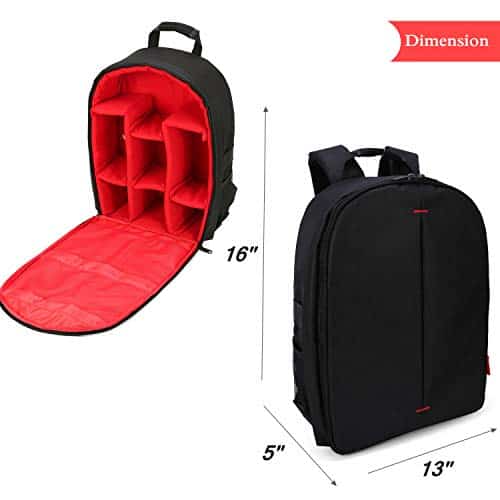
This article focuses on the black camera bag described in the earlier Proton-Pack review as approximately 16 × 13 × 5 inches, with padded dividers and a rain cover. It is a legacy product review: the brand’s current listings include other sizes and styles, and we could not independently verify the exact original model as current stock. Consequently, no new hands-on testing or universal compatibility is claimed.
What do the earlier product descriptions say?
| Brand and product family | G-raphy/i-graphy camera backpack with rain cover, originally described for DSLR and mirrorless equipment |
|---|---|
| Original size claim | Approximately 16 × 13 × 5 inches in the older article; other G-raphy variants have different measurements |
| Divider layout | Adjustable padded sections intended for one camera body and additional lenses |
| Accessories | Small-item pockets and an exterior tripod or monopod attachment described for some variants |
| Access | Earlier review described a side-access opening; confirm it on the exact bag being sold |
| Weather protection | Weather-resistant fabric plus a separate rain cover |
| Current availability | Varies; similarly named variants and second-hand listings remain visible |
The available independent descriptions are inconsistent: one older G-raphy model overview gives 14 × 10 × 5 inches, whereas other retailer listings refer to a 16 × 13 × 5-inch style. A product listed as “G-raphy camera backpack” could therefore be a different bag from the one pictured here. Measure the specific item and request interior dimensions when a seller does not publish them.
Adjustable dividers: the main reason to consider it
The core benefit of a padded camera backpack is that lenses and camera bodies do not have to sit loose against each other. G-raphy’s adjustable dividers aim to separate these items while allowing the compartments to be reconfigured for different camera sizes. That is especially useful if you alternate between a small mirrorless kit and a larger DSLR with an attached zoom.
The fit claim should be treated cautiously. Several older descriptions say a camera with an attached lens plus three or four extra lenses may fit, but one large telephoto can take more room than several compact primes. First measure the body and longest mounted lens, then arrange dividers around the real equipment rather than counting available slots.
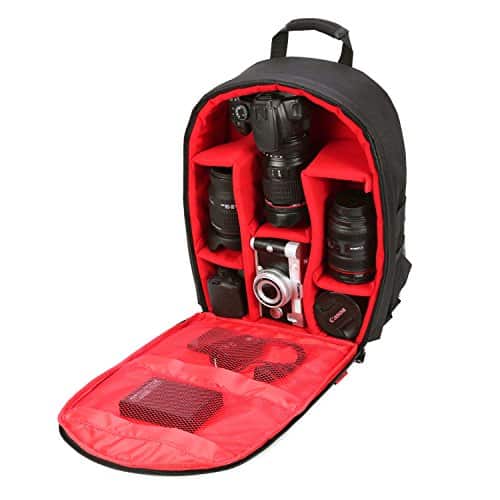
Retailer-hosted G-raphy product image imported for this guide. This does not represent a new independently documented product test.
Side access and everyday shooting
A side-access hatch can make it easier to reach a camera while moving between photography locations. However, it only helps if the mounted camera and lens can clear the opening and the divider layout keeps them near it. Even a bag advertised as quick-access can feel awkward when overpacked.
If your style of photography involves frequent lens changes, compare this design with a shoulder bag or more specialized side-access backpack. Our camera backpack versus shoulder bag comparison outlines the practical trade-offs.
Carry comfort and long trips
Padded straps and a compact shape can make a backpack more pleasant to carry than loose camera equipment in a general-purpose bag. Still, comfort cannot be guaranteed from a product photo. The amount of weight and how it sits near your back matter, particularly on long days. Several G-raphy variants advertise differently shaped shoulder and waist support, so inspect the exact configuration you are considering.
Think about what else you need on a trip. A camera-first backpack with densely packed dividers may have little room for a jacket, food or another personal item. If you are planning long outdoor trips, a hiking-oriented camera backpack or a hybrid bag with a separate camera insert may be more suitable.
Rain-cover protection and the limits of waterproof claims
Some G-raphy listings use the word “waterproof,” but the earlier product description also referred to weather-resistant nylon and a removable rain cover. Those statements are not equivalent. A rain cover helps limit direct exposure from showers, while seams, zippers, the back panel and the opening itself may still admit moisture.
For sensitive electronics, treat a cover as useful supplementary protection rather than a guarantee against soaking or submersion. Read our waterproof versus water-resistant backpack guide for more detail.
Tripod attachments and extra storage
A compact tripod holder can free up interior camera storage, but the tripod needs to be secured without pulling the load uncomfortably to one side. Some G-raphy variants provide pockets and exterior mounting points, while others have much simpler designs. Do not assume that the exact same attachments are included with every similarly named product.
Plan a place for batteries, memory cards, a cleaning kit and small cables so they cannot press against the lens or screen. Our camera packing guide explains how to organize a camera-first backpack in a repeatable way.
Strengths and weaknesses
Reasons the older G-raphy design may appeal
- Adjustable padded storage can suit a range of modest camera kits.
- A compact camera-focused layout can be less cumbersome than a large professional backpack.
- Side access, where provided, may help with camera retrieval.
- A separate rain cover provides a useful barrier against ordinary showers.
- Retained retailer photographs help identify what a specific used or older-stock listing should look like.
Reasons to choose something else
- Several different products share the G-raphy name, so dimensions and included features are easy to confuse.
- Published lens-count claims do not guarantee the fit of large modern equipment.
- Weather-resistant construction is not necessarily waterproof.
- An older bag may have wear to dividers, stitching, zippers or the rain cover.
- Current manufacturer support, warranty conditions and stock for the exact original model are unclear.
What to inspect on a used or legacy listing
- Compare the listing photos with the earlier product views and ask the seller for the actual external and internal dimensions.
- Request photographs of the open divider layout and the back and side access points.
- Check zippers, stitching, strap attachment points and the interior foam for wear.
- Confirm whether the rain cover and tripod attachment are included.
- Measure your camera with its longest mounted lens before relying on a seller’s compatibility list.
- Read return terms and compare the price with a newer bag that has clear product specifications.
How it compares with other budget camera backpacks
The Acuvar Professional DSLR backpack is another lower-cost padded option with a rain cover, while the older Vivitar camera backpack and original Amazon Basics DSLR backpack emphasize basic padded organization. For a different layout with a laptop compartment, consider the USA GEAR S17. They are separate designs, so compare real equipment fit and price instead of assuming the product labels are equivalent.
Frequently asked questions
Is the G-raphy camera backpack waterproof?
No reliable complete-product immersion rating was established for this older model. The earlier marketing description included a weather-resistant outer fabric and rain cover, which should not be interpreted as a waterproof seal.
Will it fit my DSLR or mirrorless camera?
Possibly, depending on body size, mounted lens, dividers and the access opening. Broad brand-compatibility claims are not enough; verify dimensions with the exact product listing.
Does it have space for a laptop?
Some other G-raphy camera backpacks advertise laptop compartments, but this does not establish laptop compatibility for the earlier 16 × 13 × 5-inch model. Check the exact bag and sleeve size.
Can I still buy the original model?
Listings vary by region and model, and some are second-hand or imported. Current availability for the precise older variant is not independently confirmed. Check the seller’s photographs and measurements carefully.
Verdict: useful design, but identify the actual variant
A padded G-raphy backpack with a fitted rain cover may be a reasonable budget choice for a small-to-medium camera kit. The uncertainty is not whether adjustable padded compartments can be useful—they can—but whether the specific bag available now is the same model as the one originally reviewed. Without consistent measurements or verified current support, it should remain a comparison candidate rather than an unconditional recommendation.
Check the original G-raphy affiliate destination. The earlier article also included an Amazon Canada search affiliate destination. They are retained for continuity, but live inventory and the final redirect targets were not independently verified.
Sources and transparency: Legacy product descriptions and model variations were cross-checked against WearableTech’s earlier overview and the retailer listing for a larger version. Specifications that cannot be established consistently are identified as uncertain. Product photos are previously used retailer photographs. This is research-based guidance, not an assertion of firsthand testing.