

Best Dry Bag for Kayaking | Protect Your Gear
Affiliate disclosure: This article contains affiliate links (paid links). If you buy through them, Proton-Pack may earn a commission at no extra cost to you. As an Amazon Associate I earn from qualifying purchases. Learn about our editorial policy.
A useful dry bag for kayaking should protect its contents against the type of water exposure its manufacturer actually specifies. That means looking past bright colours, waterproof marketing language and litre ratings to evaluate the material, welded seams, closure and available sizes. A soft dry bag may help keep belongings dry, but it does not replace a padded case for a delicate camera and it should never be assumed to tolerate prolonged submersion.
This updated comparison revisits four brands from the original Proton-Pack article: KastKing, Ultra Dry Adventurer, Earth Pak and Unigear. It uses their published product specifications where possible and distinguishes older affiliate listings from current model families. No independent immersion or puncture testing is claimed.
Dry bags at a glance
| Dry bag | Why compare it | Limitation |
|---|---|---|
| KastKing roll-top dry bags | 500D PVC fabric and welded seams advertised in the official collection | Different designs and sizes need model-specific checks |
| Ultra Dry Adventurer 10 L | A compact roll-top product with a separate phone pouch in the manufacturer’s listing | Don’t assume the phone pouch and main bag have identical tested water ratings |
| Earth Pak Original Series | Clear 5 L, 10 L and 20 L sizing and 500D PVC specification | Litre capacity is affected by the closure and usable opening |
| Unigear Floating Dry Bag | Range of small and larger roll-top capacities with a manufacturer statement about brief immersion | Manufacturer explicitly says its bags are not intended for prolonged submersion |
1. KastKing: reinforced roll-top dry bags
KastKing’s official dry-bag collection describes heavy-gauge 500D PVC, welded seams and a double-overlap roll-top closure. Those specifications make the family relevant to compare when choosing a bag for clothing or other water-sensitive personal belongings. Strong fabric is useful, but it is only one component of whole-bag water resistance.
The exact capacity, straps, shape and accessories depend on the product variant. An older listing that says “KastKing dry bag” is not enough to establish whether the current product has the same design. Check the maker’s complete product page and never assume a soft dry bag is a waterproof protective camera case simply because its fabric is described as waterproof.
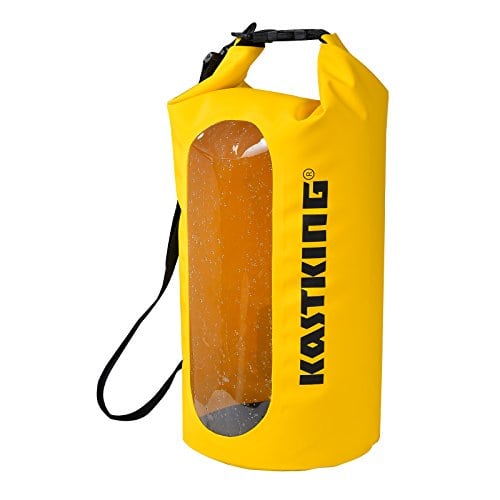
KastKing product photograph imported from a retailer-hosted image. Product variants, attachments and colours may differ.
2. Ultra Dry Adventurer: compact bag with phone pouch
The Ultra Dry Adventurer 10 L is marketed as a roll-top dry bag for a small collection of essentials. The maker lists 500D waterproof material, welded construction, a removable shoulder strap and a separate protective phone pouch. A 10 L bag can be more manageable than a larger outdoor sack when the contents are limited to clothing and small personal items.
Be careful with the product’s protection claims. The company describes waterproof performance and provides its own rating terminology, but buyers should check the specific bag and phone pouch separately, including their limitations. A bag’s claim does not prove that an expensive phone or camera would remain undamaged in every exposure situation.
The included phone pouch also needs to fit the actual phone, including any case. A pouch advertised as compatible with phones in general may be too small for a larger device.
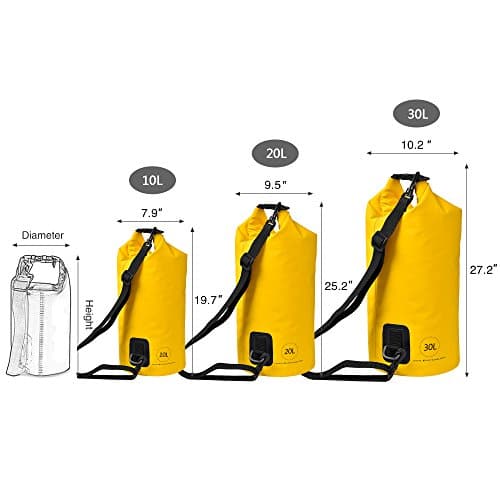
3. Earth Pak Original Series: clear size choices
The Earth Pak Original Series is available in 5 L, 10 L and 20 L sizes in the current manufacturer catalog. Earth Pak describes the bags as constructed from 500D PVC and offers a five-year warranty under its published terms. That makes it a useful family to compare when the amount of gear is already known.
An important detail is that Earth Pak itself says the functional volume changes depending on how much of the top is rolled or closed. Advertised litres do not represent an immutable usable volume, and the opening must still accommodate the actual items. Test the dimensions against a padded camera insert or other objects rather than assuming any 20 L bag is a safe place for a large camera.
Water protection limit: Earth Pak’s own product FAQ describes its Original bags as IPX5-rated and designed to float, not as fully submersible equipment cases. It warns against submerging the bag for more than a few seconds. For a valuable camera, use a suitably padded waterproof case when submersion or hard impacts are realistic possibilities; a soft roll-top bag alone is not equivalent.
A separate dry bag can also be useful to organize clothing inside a larger outdoor bag, but its protection is different from a rigid camera case. Use the full manufacturer specification to assess it.
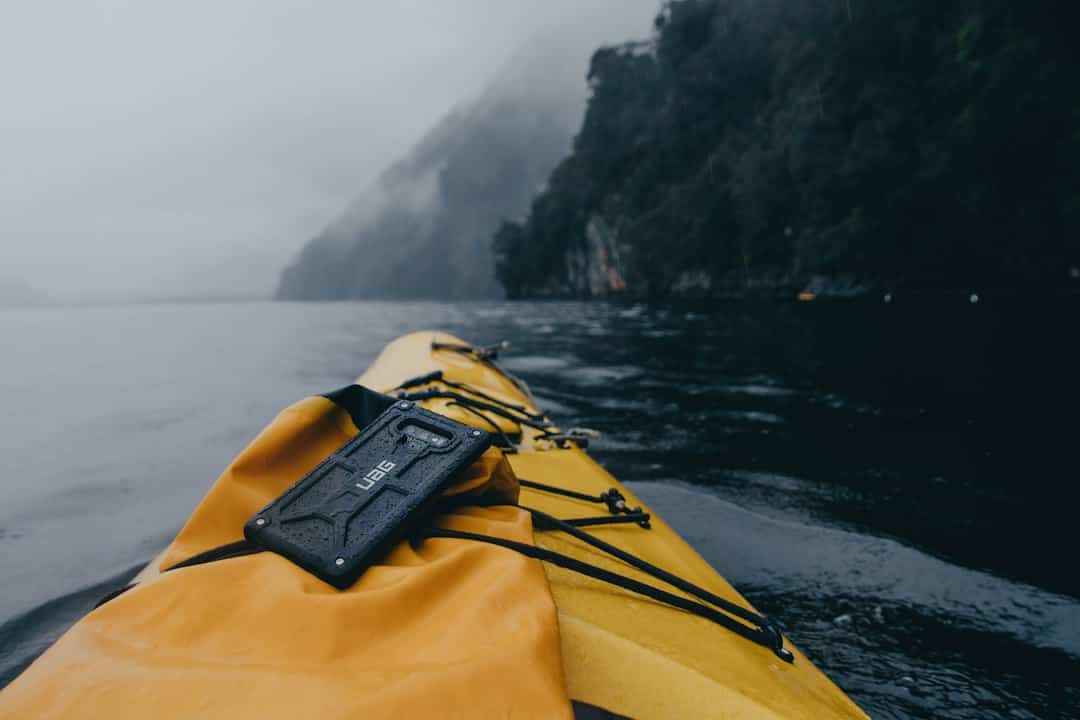
Kayaking and dry-bag photograph by Mikail McVerry via Unsplash. Illustrative use case, not an Earth Pak product photograph or waterproofness test.
4. Unigear: multiple sizes and explicitly stated limits
Unigear’s official roll-top dry-bag family lists capacities including 2, 5, 10, 20, 30 and 40 L, depending on the chosen variant. The manufacturer describes PVC construction, welded seams and a roll-top closure, and emphasizes protection against splashes or brief immersion.
Its published FAQ also states that prolonged submersion is not recommended. That is an important, practical limitation that should not be obscured by broad “100% waterproof” descriptions. Large sizes may be useful for bulky soft goods, but the extra capacity is not automatically suitable for protecting cameras against impacts.
Which dry-bag size makes the most sense?
- Small 2–5 L: compare for a phone pouch, compact accessories or a very small personal-items kit.
- Medium 10–20 L: more flexibility for several clothing items and compact accessories, subject to the opening dimensions.
- Larger 30–40 L: useful to compare for bulkier items, but extra material and pack size can be cumbersome.
- Camera equipment: measure the camera and any padded insert first; do not select solely by volume.
No single litre size is right for everybody. Shape, closure space and what needs to remain protected are more important than choosing the largest available option. For expensive electronics, a properly rated protective case may be a better solution than a general-purpose soft dry bag.
Water resistance, waterproof claims and IP ratings
A waterproof material panel is not the same as a waterproof complete product. Seams, closure wear and use conditions matter. If a bag or phone pouch has an IP rating, make sure that rating applies to the exact complete item, and compare its stated test conditions with your needs. Some makers publish careful limitations while others use general marketing language.
Our waterproof vs water-resistant backpack guide explains the distinction and why an ordinary backpack rain cover is not an immersion-proof seal.
What about phones, GoPros and cameras?
A smartphone or action camera often has very different impact and moisture-protection needs from a folded jacket or towel. A soft bag can create a moisture barrier when appropriately designed, but it provides limited padding against crushing. A separate protective pouch or hard case may be useful when the manufacturer’s ratings and dimensions match the equipment.
For camera-focused accessories, read GoPro carrying cases compared and our dry-bag guide for cameras and phones. Both explain why storage cases and waterproof protective cases serve different roles.
Common mistakes when evaluating dry bags
- Assuming every product in one manufacturer’s range has the same protection rating.
- Treating a soft dry bag as a substitute for impact-resistant camera padding.
- Ignoring the usable opening and closure space.
- Relying on a product title to imply safe prolonged immersion.
- Ignoring wear, punctures or damaged seams and closure components.
- Comparing products only by capacity or colour instead of intended exposure and construction.
Frequently asked questions
Can dry bags be fully submerged?
Some products may specify limited immersion conditions, while others are intended only for splashes and rain. Unigear explicitly warns against prolonged submersion for its roll-top bags. Check the exact maker’s protection statements rather than relying on generic category claims.
Are dry bags the same as waterproof camera cases?
No. A dry bag primarily addresses moisture exposure; a purpose-built camera case may offer rigid or padded impact protection as well as a documented water-resistance rating.
What is the advantage of welded seams?
Welded seams can reduce water-entry paths compared with ordinary stitched seams, but the performance of the entire bag still depends on the closure and its condition.
Is a 20 L bag twice as useful as 10 L?
Not necessarily. The extra capacity can be valuable for bulkier gear, but it may also be larger than needed, and the roll-top closure affects usable volume.
Verdict: compare limits as carefully as features
KastKing, Ultra Dry Adventurer, Earth Pak and Unigear all offer dry bags worth comparing for the type of exposure they explicitly support. Earth Pak provides clear volume options; KastKing emphasizes reinforced PVC construction; Ultra Dry bundles a phone pouch with some models; and Unigear clearly describes brief-exposure protection along with a warning about prolonged immersion. None should be described as universally safe for electronics or submersion.
The original article’s affiliate destinations remain available: KastKing, Ultra Dry, Earth Pak original dry bag, Unigear, original Amazon product link, and additional legacy product link. Redirects and inventory have not been independently confirmed.
Source and affiliate disclosure: Product descriptions are based on the official pages from KastKing, Ultra Dry Adventurer, Earth Pak, and Unigear. No new waterproofing tests were conducted by Proton-Pack. Legacy retailer photos illustrate the products. Affiliate links may earn a commission.