

Altura Photo DSLR Camera Backpack Review
Affiliate disclosure: This article contains affiliate links (paid links). If you buy through them, Proton-Pack may earn a commission at no extra cost to you. As an Amazon Associate I earn from qualifying purchases. Learn about our editorial policy.
Is the older Altura Photo DSLR camera backpack worth considering? Its appeal is familiar: a padded, adjustable camera compartment, room for several lenses, useful accessories and a straightforward two-shoulder carrying system. But Altura Photo has used similar names on multiple bags. This article addresses the older DSLR backpack pictured in Proton-Pack’s original review, rather than assuming its specifications apply to the later Altura sling or larger Great Explorer backpack.
The previous review promised comfort over long walks and described a blanket 90-day satisfaction guarantee without documenting a test or confirming today’s warranty terms. This revision separates the older seller-described features from verifiable buying considerations. It is a research-based legacy-product guide, not a newly conducted field test.
Which Altura Photo model is this?
The original article described a conventional two-shoulder padded DSLR backpack intended for one DSLR with a lens attached, several additional lenses, flash equipment and a compact tripod. It also mentioned an interior padded slip pocket, nylon construction and adjustable straps. However, the original page did not identify a reliable SKU, and Altura sells other backpacks with different configurations.
| Product described | Older Altura Photo DSLR / mirrorless camera backpack, two-shoulder style |
|---|---|
| Original advertised load | One DSLR with attached lens; around four to five additional compact lenses and a flash |
| Interior | Removable or adjustable padded dividers, plus a slip pocket beneath the lid |
| Exterior | Nylon textile described as weather-resistant in legacy listing material |
| Carrying system | Two adjustable padded shoulder straps |
| Tripod transport | External tripod or monopod support described in the older article |
| Exact dimensions, weight, current warranty | Not independently established for the precise older variant |
These are legacy listing claims, not independent measurements. An Altura Great Explorer listing identifies that different model as KZ0274, with a laptop compartment and a removable rain cover. Those Great Explorer features should not be transferred to the older bag in this review. Likewise, the Altura sling reviewed by Shotkit is a single-strap product with different fit and accessory provisions.
What can the padded compartment realistically hold?
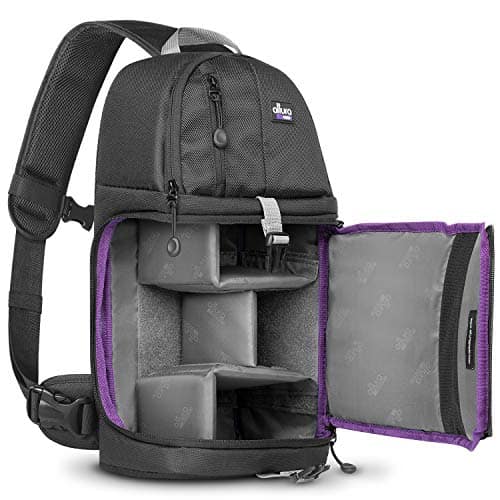
A configurable divider system helps keep the camera and lens barrels separated from one another. Advertised counts such as “five additional lenses” are useful only when those lenses are relatively compact. A long telephoto zoom can take the space of several smaller prime lenses, especially with its hood, collar or a battery grip attached to the camera.
Measure your largest assembled camera and lens first. Then ask whether the bag has enough depth for that combination without pressing against buttons, the lens barrel or the zipper panel. Pack additional lenses only after establishing a stable camera position. Avoid treating every Canon, Nikon, Sony or other camera body as automatically compatible.
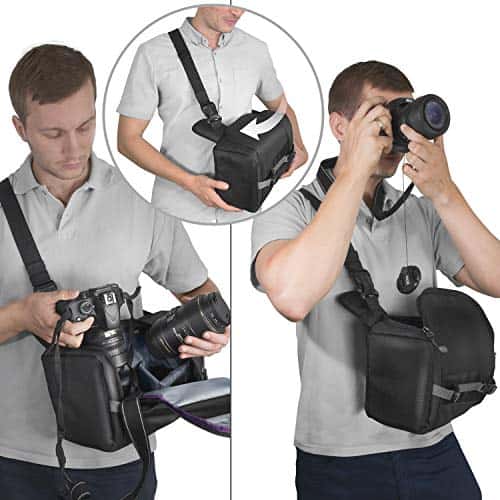
Retailer-hosted product image used to illustrate this older Altura design. This image illustrates the product, not a documented independent wear or durability test.
How to organize accessories without damaging camera gear
Place hard accessories such as chargers, camera mounting plates and tripod heads in their own sleeves or pockets. Keeping them loose alongside a lens risks scratching the lens surface or other delicate camera parts. Memory cards and spare batteries are easier to find in a dedicated zipped pouch than buried between padded dividers.
The padded compartment should fit the core camera kit snugly, but do not compress the dividers so hard that closing the backpack strains the main zipper. Our updated camera backpack packing guide explains a repeatable layout for longer lenses, spare equipment and small items.
Carrying comfort: evaluate the loaded bag, not the description
Two padded shoulder straps are generally useful when moving a moderately heavy camera kit between shooting locations. But strap padding alone cannot establish whether a backpack will be comfortable on a particular photographer. Bag length, load distribution, the location of the heaviest lens and personal fit all play a role.
If you expect to hike for several hours, also consider how much room remains for a jacket, water and other personal items. A camera-only interior can protect equipment well but leave limited general storage. Test the loaded configuration if possible rather than relying on marketing phrases such as “no fatigue” or “ultimate comfort.”
What does weather-resistant mean for this bag?
A retailer’s use of “weather-resistant nylon” does not establish a waterproof rating for a complete backpack. Zippers, stitching and an open camera access panel remain potential paths for water. For a bag containing expensive electronics, use appropriate additional weather protection and avoid leaving it exposed in sustained heavy rain.
The larger Great Explorer variant has been advertised with a removable rain cover, but we cannot verify that the same cover was included with the exact older variant shown here. Check the specific listing and seller’s photos. For a detailed explanation, read waterproof versus water-resistant backpacks.
Advantages and drawbacks
Reasons to consider it
- Adjustable padded dividers can support a modest camera-and-lens kit.
- A traditional backpack shape can make carrying several lenses more convenient than a small shoulder bag.
- The older design includes compartments for some accessories rather than leaving equipment loose.
- Existing product photographs make it possible to identify the legacy style when comparing used listings.
- For a genuinely low asking price, a well-preserved example may suit casual photography.
Reasons to choose something else
- No reliably confirmed dimensions or SKU for the exact older model were found.
- Advertised lens counts may exaggerate compatibility with modern large lenses or gripped bodies.
- Current seller warranty, return terms and manufacturer support should not be assumed from an old Digital Goja guarantee.
- Weather resistance is not evidence of waterproof or immersion-safe construction.
- A larger professional kit or frequent side-access requirement may justify a different backpack.
Inspecting an older or second-hand Altura bag
Check the main zipper, side seams and shoulder strap attachment points. Make sure divider padding is still firm, hook-and-loop fasteners hold securely and no accessory pockets are torn. If there is a rain cover or tripod attachment, verify that those accessories are actually included rather than shown in an unrelated product photo.
Compare the seller’s images with the two older product photos on this page. If they differ substantially, ask for an exact model reference and interior measurements. Altura’s sling and Great Explorer are not simply interchangeable sizes of the same camera bag.
Alternatives for different types of photography
For another entry-level padded design, compare the original Amazon Basics DSLR backpack and the Acuvar Professional DSLR camera backpack. The USA GEAR S17 is another option with different access and storage arrangements. If you need several openings, compare the original Lowepro ProTactic 350 AW.
These are not direct model-for-model substitutes. Choose based on the largest camera-lens assembly, access requirements, real laptop dimensions and total carrying weight. A currently supported backpack with clear dimensions may offer better value than uncertain older stock even at a somewhat higher price.
Frequently asked questions
Will the older Altura backpack fit a full-frame DSLR?
Possibly, depending on the body’s actual dimensions, the attached lens and the divider layout. The original camera compatibility claims do not establish that every full-frame DSLR or telephoto fits.
Is it the same as the Great Explorer?
No. The Great Explorer is a separately identified Altura backpack with distinct dimensions and a laptop/tablet layout. Do not use its dimensions as specifications for this older bag.
Does the original bag have a verified rain cover?
Not from the material we could confidently associate with the specific pictured model. Check the seller’s precise listing rather than assuming every Altura backpack includes the same accessories.
Is this a current best-buy recommendation?
Not without verified current stock, price and model identification. This guide helps assess a legacy bag’s design and compare it with better-documented alternatives.
Verdict: potentially useful, but verify the exact model
The older Altura Photo DSLR backpack is a reasonable design to compare if you need padded camera organization in a conventional backpack. Its major drawback today is uncertainty over the precise SKU, interior size and manufacturer support. Treat it as a legacy buying reference, not an unconditional endorsement of whatever an online listing now calls an “Altura Photo DSLR camera backpack.”
Check the original Altura affiliate destination. This link was preserved from the earlier article, but the final redirect, product generation, stock and price have not been independently verified. Confirm the retailer’s exact item before ordering.
Sources and editorial policy: This research-based review draws on the legacy Proton-Pack product description, the separate Altura Great Explorer listing, and Shotkit’s distinct sling review to avoid confusing versions. No fresh hands-on testing is claimed. Existing retailer photos are illustrative; affiliate links may generate commissions.
