

Camera Backpacks and Bags for Air Travel
Affiliate disclosure: This article contains affiliate links (paid links). If you buy through them, Proton-Pack may earn a commission at no extra cost to you. As an Amazon Associate I earn from qualifying purchases. Learn about our editorial policy.
The best camera backpack for air travel is one that protects your gear, fits your actual equipment and qualifies for the baggageallowance on your specific flight. A compact backpack may be an ideal cabin carry-on, but a bag that fits one airline’s overhead allowance can still exceed another airline’s personal-item rules. The outer dimensions of the packed bag—not its advertised camera capacity—are what matter at check-in.
This guide explains how to compare backpack and shoulder-style camera bags for air travel. It also revisits five older models from the original Proton-Pack article without describing outdated bags as current top picks. Airline policies change, so use the current official allowance for your ticket and all operating carriers before buying or packing a bag.
Start with the airline’s allowance, not the backpack
For example, Air Canada’s current carry-on policy lists a standard carry-on maximum of 23 × 40 × 55 cm (depth × width × height), and a personal item maximum of 33 × 43 × 16 cm. Air Canada’s Conditions of Carriage prints the same three measurements as 16 × 33 × 43 cm; consult the size diagram and measure your fully packed bag rather than assuming the listed order describes its orientation. These dimensions include handles and external attachments. The airline also specifies that certain Economy Basic fares purchased on or after January 3, 2025 permit only a personal item on specified itineraries.
That distinction matters for photographers: a 48 cm tall camera backpack might fit a standard overhead allowance but be too tall for an under-seat personal item. Larger cameras, laptops and lenses can add weight even when the bag technically fits the dimensional limit. Check your ticket, route and fare rather than assuming every cabin bag is free.
| Standard carry-on (Air Canada example) | Maximum 23 × 40 × 55 cm, including external parts; not the same as a personal item. |
|---|---|
| Personal item (Air Canada example) | Maximum 33 × 43 × 16 cm; significantly more restrictive in depth and height. |
| Other airlines and codeshare flights | Allowances differ, including on budget fares and flights operated by a partner carrier. |
| Camera gear | Protect against impact, verify the bag’s internal fit and follow current security rules for batteries and accessories. |
Camera backpack vs camera shoulder case for flying
Backpacks usually suit photographers carrying a camera, several lenses, laptop and personal items. Padded dividers are useful for keeping equipment organized and reducing unwanted contact. The limitation is the bag’s physical size: a padded professional backpack can be too deep for a personal-item allowance and may be bulky in a narrow cabin.
A small shoulder or top-loading camera case is a different solution, best for one camera with a lens attached and a few accessories. Such bags can be easier to retrieve from a larger carry-on or fit beside personal items, but they are not equivalent to a multipurpose backpack. Several older products in the original article were actually holster-style or top-loading bags, so they are separated from true backpacks here.
An up-to-date backpack reference: Thule Covert DSLR 24 L
A clearly specified modern model is the Thule Covert DSLR Backpack 24 L, model 3205343. Thule lists dimensions of 33 × 23 × 48 cm, a weight of approximately 1.9 kg, a removable camera pod, side access and a laptop pocket marketed for up to a 16-inch MacBook Pro or 14-inch PC.
Its published exterior dimensions fall within the standard Air Canada carry-on dimensions cited above if packed without protrusions, but it exceeds that airline’s personal-item height and depth limits. This illustrates why the same camera bag may be appropriate for one fare and not another. Always verify the operating airline’s rules and actual packed measurements.
Four camera backpacks compared with Air Canada cabin limits
Air Canada publishes a standard carry-on maximum of 23 × 40 × 55 cm (depth × width × height). Its carry-on page lists personal-item limits of 33 × 43 × 16 cm, while its Conditions of Carriage lists those three side lengths in the order 16 × 33 × 43 cm. Treat the personal-item limit as a very shallow, small bag allowance rather than relying on the order of the dimensions alone. The following is a preliminary size comparison using manufacturer-stated exterior dimensions; it is not airline approval or a guarantee of cabin acceptance.
| Camera backpack | Manufacturer exterior size | Standard carry-on | Personal item |
|---|---|---|---|
| Lowepro Flipside 200 AW II | 24.5 × 20 × 43.5 cm | Within the published maximum on paper | Exceeds the personal-item limit |
| Lowepro ProTactic BP 350 AW III | 19 × 31.5 × 47 cm | Within the published maximum on paper | Exceeds the personal-item limit |
| Thule Covert DSLR 24 L | 33 × 23 × 48 cm | Within the published maximum on paper | Exceeds the personal-item limit |
| Lowepro ProTactic BP 450 AW III | 23 × 34.5 × 51 cm | Within the published maximum on paper | Exceeds the personal-item limit |
All four models fall within the published standard carry-on maximum when the stated external dimensions are oriented appropriately. None meets the smaller personal-item limit. An attached tripod, overstuffed pocket or equipment protruding from the bag may increase its real size. Especially on fares that only include a personal item, a camera backpack marketed as “travel friendly” should not be assumed to qualify.
Review the current Air Canada carry-on policy and your ticket details before travelling. The operating airline, aircraft and fare may have different restrictions. Measure the bag fully packed, including handles and external attachments.
Legacy camera bags from the original comparison
Evecase professional shoulder or holster case
The Evecase camera shoulder/holster from the original list is intended for compact, camera-first carry rather than use as a full travel backpack. It is worth considering as a type of protective case for one camera and accessories, but the precise legacy model’s current inventory, dimensions and warranty were not verified. Compare the actual opening and padding before assuming a large camera fits.
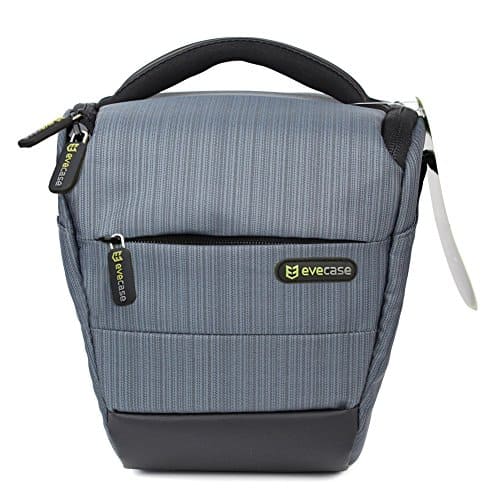
Evecase product photograph imported from a retailer-hosted image for identification. This is not a newly tested product or a confirmed current airline-approved case.
Ape Case ACPRO1800 and ACPRO2000
The original guide listed two Ape Case models, the smaller ACPRO1800 and larger ACPRO2000. They belong to the camera-backpack category, but older online listings differ in measurements, padding layouts and exact accessories. They are useful for comparing compact-versus-large equipment capacity, not as guaranteed fits for any particular airline allowance.
For either model, check the seller’s measured exterior dimensions and the size of the padded camera compartment. A larger camera pack can carry more lenses but may become a poor choice for frequent under-seat use. If current manufacturer specifications and return terms are unavailable, a newer bag with documented dimensions may be easier to choose confidently.
Case Logic SLRC-206 DSLR and laptop backpack
The Case Logic SLRC-206 is another older camera-and-laptop backpack featured in the previous article. Its design combined padded camera storage with a separate laptop area. Because the model is older, compare the exact variant, padding condition and real laptop dimensions before treating it as a current alternative. A laptop’s diagonal screen size does not guarantee it fits a sleeve.
Travel illustration by Josh Sorenson via Unsplash. Not a Case Logic backpack or evidence of airline approval.
Lowepro Adventura TLZ 25 top-loading bag
The original Lowepro Adventura TLZ 25 was a top-loading camera shoulder case, not a travel backpack. It is best understood as compact padded storage for a camera with a mounted lens. Its capacity, access and intended use differ from a backpack meant to carry a laptop and spare clothing. Do not compare its dimensions with full backpacks without making that difference clear.
Choosing a travel camera bag by equipment
- One camera and one lens: a protective holster, shoulder case or small insert may be sufficient.
- One camera and several lenses: consider a compact backpack with dividers and confirmed cabin dimensions.
- Camera and editing laptop: verify the actual laptop sleeve size and the bag’s weight when packed.
- Two cameras and large telephoto lenses: expect significantly more space and weight; check the specific fare’s baggage allowance.
- Travel with personal items: choose a bag that leaves room for essentials without crushing padded camera compartments.
What to consider about camera batteries
Camera and laptop batteries are subject to airline and aviation-security policies. For Canadian departures, CATSA advises carrying batteries and battery-powered devices in cabin baggage, and protecting spare battery terminals from contact with keys, coins or other metal objects. Check the operating airline’s restrictions as well, particularly for larger-capacity batteries. Canada’s airport-security authority publishes current guidelines for lithium batteries, including distinctions between batteries installed in equipment and spare batteries, and allowances that can depend on watt-hour rating and airline approval. The safest approach is to read the carrier and security authority’s current guidance for your specific equipment rather than relying on older blog advice.
Do not assume a generic camera backpack purchase settles battery or airport-screening questions. Policies may change, and international connections can involve more than one regulator and airline.
Padding and access during the journey
Separate lenses from hard adapters, tripod plates, chargers and other accessories. A camera compartment should hold everything securely without compressing lens barrels or forcing zippers. Side access may help during photography stops, while a full rear opening can be more useful when packing or organizing the whole kit.
A backpack that is excellent for an all-day photography hike can be frustrating inside an aircraft cabin, especially when its dividers leave little room for ordinary travel items. Consider the complete journey rather than the flight alone. Our camera packing guide offers a practical organization process.
Common mistakes
- Treating an airline’s standard carry-on allowance as if it also applied to under-seat personal items.
- Ignoring handles, side pockets or an attached tripod when measuring a packed bag.
- Buying by advertised camera count rather than interior dimensions.
- Assuming a 15-inch laptop sleeve fits every current 15-inch laptop.
- Treating a small holster-style case as a replacement for a full camera-and-laptop backpack.
- Relying on old airline or battery rules without checking the current official policy.
Frequently asked questions
Can I carry a camera backpack as a personal item?
Only if it meets the allowance for the specific flight, fare and operating airline. A backpack that qualifies as a standard carry-on may still be too large to count as a personal item.
Will a camera backpack fit in the overhead bin?
It may if its actual packed dimensions meet the airline’s standard carry-on allowance. Equipment and external attachments can change the shape and dimensions of the bag.
Does a padded backpack guarantee my camera won’t be damaged?
No. Padding can help with ordinary bumps and organization, but the protection depends on the bag, divider fit, equipment and how it is handled.
Should I choose a backpack or a shoulder case for a small kit?
A small shoulder or top-loading case may be adequate for one camera and lens, while a backpack is more versatile for several lenses, a laptop and longer periods of carrying.
The practical recommendation
Measure the actual packed bag, check the ticket allowance and choose the smallest padded system that comfortably accommodates your real equipment. The Thule Covert 24 L provides a current reference with clearly published specifications, while older Ape Case and Case Logic designs remain legacy options that require seller-specific verification. Small Evecase or Lowepro cases serve a different purpose from full backpacks.
Read our broader camera backpack buying guide,